
The Benazir Income Support Programme (BISP) remains Pakistan's largest social safety net, providing unconditional cash assistance to low-income families across the country. Named after former Prime Minister Benazir Bhutto, the programme was launched in 2008 and has since grown into a multi-layered welfare system covering cash support, education stipends, and nutrition assistance for mothers and children. Here is where things stand as of mid-2026.
What Is BISP?
BISP is a federal social protection programme run by the Government of Pakistan through the Ministry of Poverty Alleviation and Social Safety. Its core objective is to reduce poverty by transferring cash directly to the female head of a household, since payments are registered in women's names and male family members cannot collect them on a beneficiary's behalf. The assistance is a grant, not a loan — there is no repayment, and registration is completely free.
Eligibility is determined through the National Socio-Economic Registry (NSER), a nationwide household database. Families are assessed using a Proxy Means Test (PMT) score, which estimates household welfare based on assets, income indicators, and living conditions rather than self-reported income alone. Households scoring below a set poverty threshold qualify for support.
Latest Scheme Status: Coverage and Budget
BISP's footprint has expanded significantly heading into the 2026–27 fiscal year:
- Budget: The programme's allocation for FY2025–26 stands at roughly Rs 716 billion, around a 20% increase over the previous year. A further increase to approximately Rs 844 billion has been proposed for FY2026–27 as coverage and reforms continue to expand.
- Coverage: Under the core Benazir Kafaalat programme, quarterly cash assistance is currently reaching about 12 million households nationwide, including families in every province as well as Azad Jammu & Kashmir and Gilgit-Baltistan.
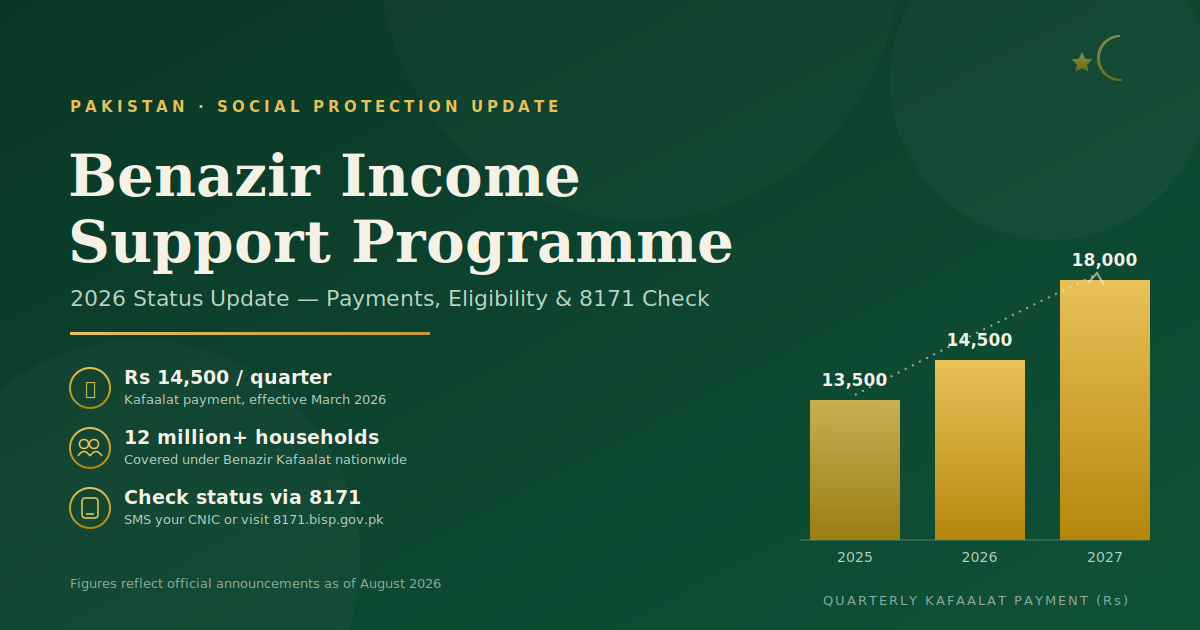
- Payment increase: The standard Kafaalat quarterly stipend, which was Rs 13,500 in early 2025, was raised to Rs 14,500 per quarter from March 2026. A further increase to Rs 18,000 per quarter is scheduled from January 2027.
Key Sub-Programmes Under BISP
BISP is no longer just a single cash transfer scheme. It now operates as an umbrella of connected initiatives:
1. Benazir Kafaalat The flagship unconditional cash transfer, paid quarterly to the female head of an eligible household via biometric verification at partner bank ATMs and agents (such as HBL and Bank Alfalah), or through JazzCash, Easypaisa, and BISP payment camps.
2. Benazir Taleemi Wazaif (Education Stipends) A conditional cash transfer tied to school enrolment and attendance, meant to keep children — especially girls — in school. It currently extends to over 12.4 million children, with continued payment linked to a minimum 70% school attendance requirement.
3. Benazir Nashonuma Focused on maternal and child nutrition, this component supports pregnant and breastfeeding women and children under two, aiming to reduce stunting and malnutrition through cash incentives and nutrition awareness.
4. Social Protection Wallet / Free SIM Rollout A newer digital initiative giving beneficiaries a mobile-linked financial wallet, supported by a nationwide rollout of free SIM cards to make digital payments and communication with BISP easier for registered families.
5. Integrated Grievance Management System (IGMS) Launched to let beneficiaries file and track complaints — such as payment delays or incorrect eligibility status — improving accountability and transparency in the programme's delivery.
Eligibility Criteria
While final eligibility is confirmed only through the official NSER/PMT assessment, generally eligible households share these characteristics:
- Classified as low-income based on the PMT poverty score
- Registered (or newly surveyed) in the National Socio-Economic Registry
- Female head of household with a valid CNIC
- No household member employed in a government job or residing abroad, as this typically disqualifies a family
- Priority given to households with women, young children, or persons with disabilities
Meeting these general factors does not guarantee approval — every application is reviewed against official criteria during the survey process.
The NSER Dynamic Survey
Because household circumstances change over time, BISP maintains the NSER as a "dynamic registry" rather than a one-time list. Families who were previously found ineligible, or whose income or household composition has changed, can request a re-survey. New applicants who have never registered can also be added through this process.
To complete or update your registration:
- Visit your nearest BISP Tehsil Office (registration desks have been established at the tehsil level nationwide).
- Bring your original CNIC and, where applicable, children's B-Forms.
- Provide biometric (thumbprint) verification.
- Answer the household questionnaire covering assets, income, and living conditions used for the poverty score.
- Collect your survey confirmation slip.
How to Check Your BISP Status (8171 Portal & SMS)
BISP's 8171 system is the official channel for checking eligibility and payment status:
- SMS method: Send your 13-digit CNIC number (without dashes) to 8171. You will receive a reply confirming your registration and eligibility status — useful for areas with limited internet access.
- Web portal: Visit 8171.bisp.gov.pk, enter your CNIC, complete the captcha, and view your real-time status, including payment history.
Note that while eligibility can be checked online, new registration itself must still be completed in person through the NSER dynamic survey process — the portal does not allow full remote registration.
A Word of Caution
BISP has repeatedly warned the public to rely only on official channels — the 8171 portal, official SMS service, or verified BISP Tehsil offices. Fake registration links, unofficial "helper" websites, and WhatsApp/SMS scams claiming to offer faster registration or approval are common; BISP does not charge any fee for registration or verification.
Summary
| Feature | Current Status (2026) |
|---|---|
| Quarterly Kafaalat payment | Rs 14,500 (rising to Rs 18,000 from Jan 2027) |
| Households covered (Kafaalat) | ~12 million |
| Children covered (Taleemi Wazaif) | ~12.4 million |
| FY2025–26 budget | ~Rs 716 billion |
| Proposed FY2026–27 budget | ~Rs 844 billion |
| Status check | 8171 SMS or 8171.bisp.gov.pk |
BISP continues to evolve from a single cash-transfer scheme into a broader social protection ecosystem covering income support, education, nutrition, and digital financial inclusion. Given that payment amounts, budgets, and survey phases are updated periodically, beneficiaries and applicants are advised to regularly verify their status through the official 8171 portal or SMS service rather than relying on unverified sources.
Sources: BISP official website (bisp.gov.pk), Ministry of Poverty Alleviation and Social Safety announcements, and financial news reporting (Mettis Global News, June 2026) on the FY2025–26/2026–27 BISP budget.